Syzygy
Syzygy (from Greek suzugia, "yoked together") means an alignment or pairing of things. The word carries distinct technical meanings across fields:
Astronomy: three celestial bodies in a straight line. The Sun–Earth–Moon syzygy occurs at every new and full moon; eclipses happen when the alignment is precise enough. Both conjunction and opposition count.
Mathematics: a relation among the generators of a module, i.e., a linear combination that equals zero. Hilbert's syzygy theorem bounds how long a chain of such relations can run, and the concept anchors free resolutions in commutative algebra.
Psychology: in Jung, the union of opposites, particularly the anima/animus pairing.
Prosody: two metrical feet treated as a single unit.
Biology: the pairing of chromosomes in meiosis, or the end-to-end association of certain protozoa before reproduction.
The common thread is two or more elements standing in a fixed, meaningful relation to each other — coupling rather than mere proximity.

Tensegrity
Tensegrity (a contraction of "tensional integrity," coined by Buckminster Fuller) means a structure that holds its shape through balanced opposition rather than mass or rigidity. The term carries distinct meanings across fields:
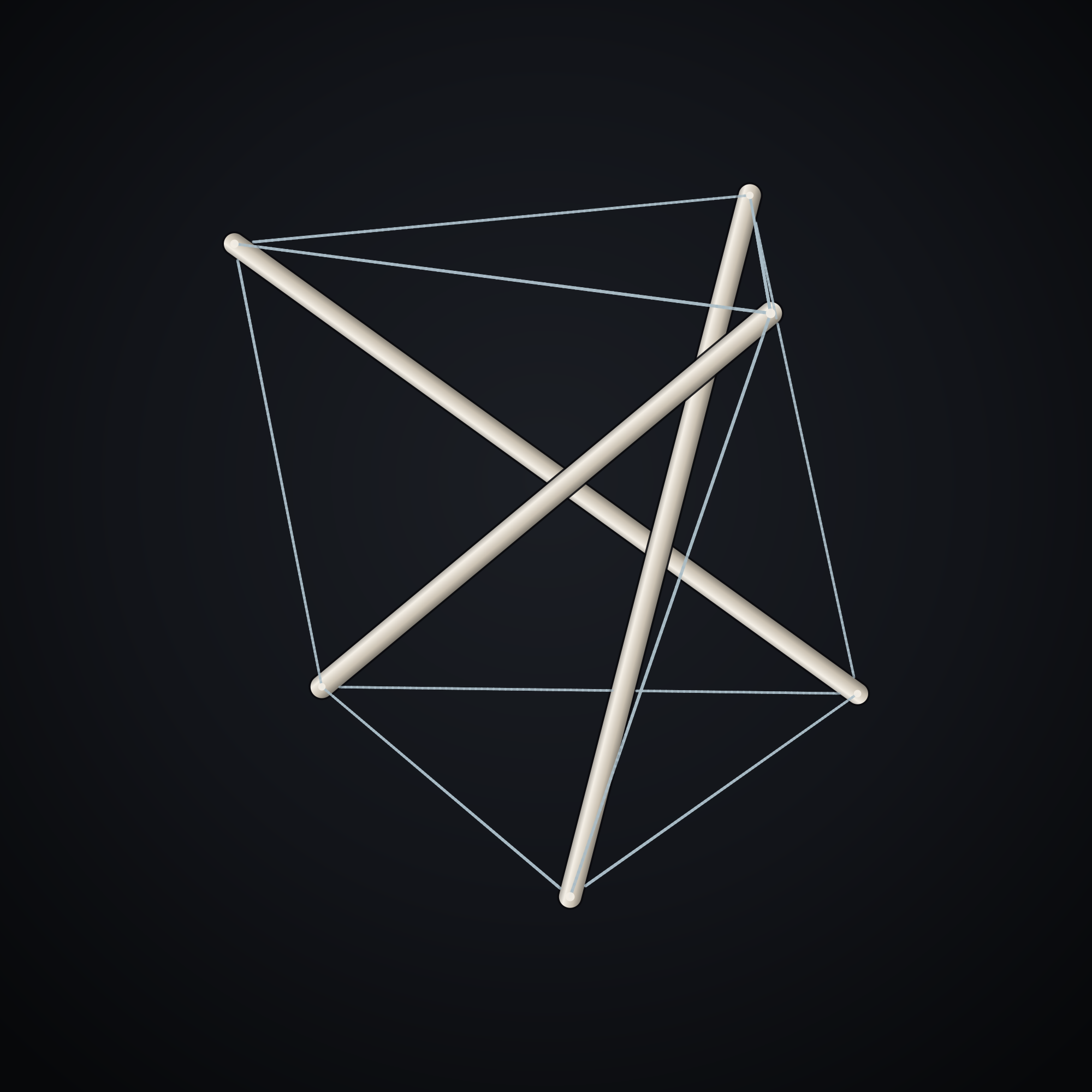
Architecture and sculpture: a system of rigid compression struts that never touch each other, floating in a continuous network of cables under tension. Kenneth Snelson built the first in 1948; Fuller named the principle and the two disputed credit for decades.
Structural engineering: more loosely, any prestressed system in which tension and compression are set against each other before any external load arrives. The Golden Gate holds its span because the towers push down while the cables pull up; neither force could carry the deck alone.
Cell biology: Donald Ingber's model of the cell as a prestressed network, microtubules acting as compression members against a tensioned cytoskeleton, which explains why cells respond to mechanical force and not only chemical signal. The extension to fascia and skeleton, "biotensegrity," is more contested.
Aerospace: the design principle behind deployable antennas and landers, where extreme strength-to-weight matters and tension members carry load without buckling.
Organizations and character: opposing principles held simultaneously rather than resolved: individualism and teamwork, a decades-long horizon and a sense of urgency, conviction and open-mindedness.
The common thread is that the opposition is the load-bearing element. A tensegrity is stable only because it is already under strain, force applied at any point redistributes across the whole system rather than concentrating where it landed, and slackening either side does not simplify the structure — it collapses it.